Superhero or Supervillain: How AI is Changing Research
CZELO coorganised a conference which highlighted current trends in grant proposal writing and evaluation from the perspective of increasing artificial intelligence use.
On Tuesday, 20 October, the Permanent Representation of Hungary to the EU hosted a conference on the impact of artificial intelligence on science, research and innovation. The Czech Liaison Office for Education and Research in Brussels (CZELO) co-organised the event together with its partner offices from Hungary (NRDIO), Poland (PolSCA) and Slovakia (SLORD). Participants discussed the use of AI in both the preparation and evaluation of grant applications, as well as groundbreaking scientific applications of AI, including autonomous physical experiments.
Artificial intelligence (AI) is becoming an increasingly important topic in science and research. As AI continues to evolve, it is reshaping the research landscape and attracting growing attention from researchers and policymakers at both national and European levels. The Visegrád Four (V4) liaison offices organised the conference in Brussels to discuss European policies on AI in science, its use in drafting and evaluating grant proposals, and its impact on research funding.
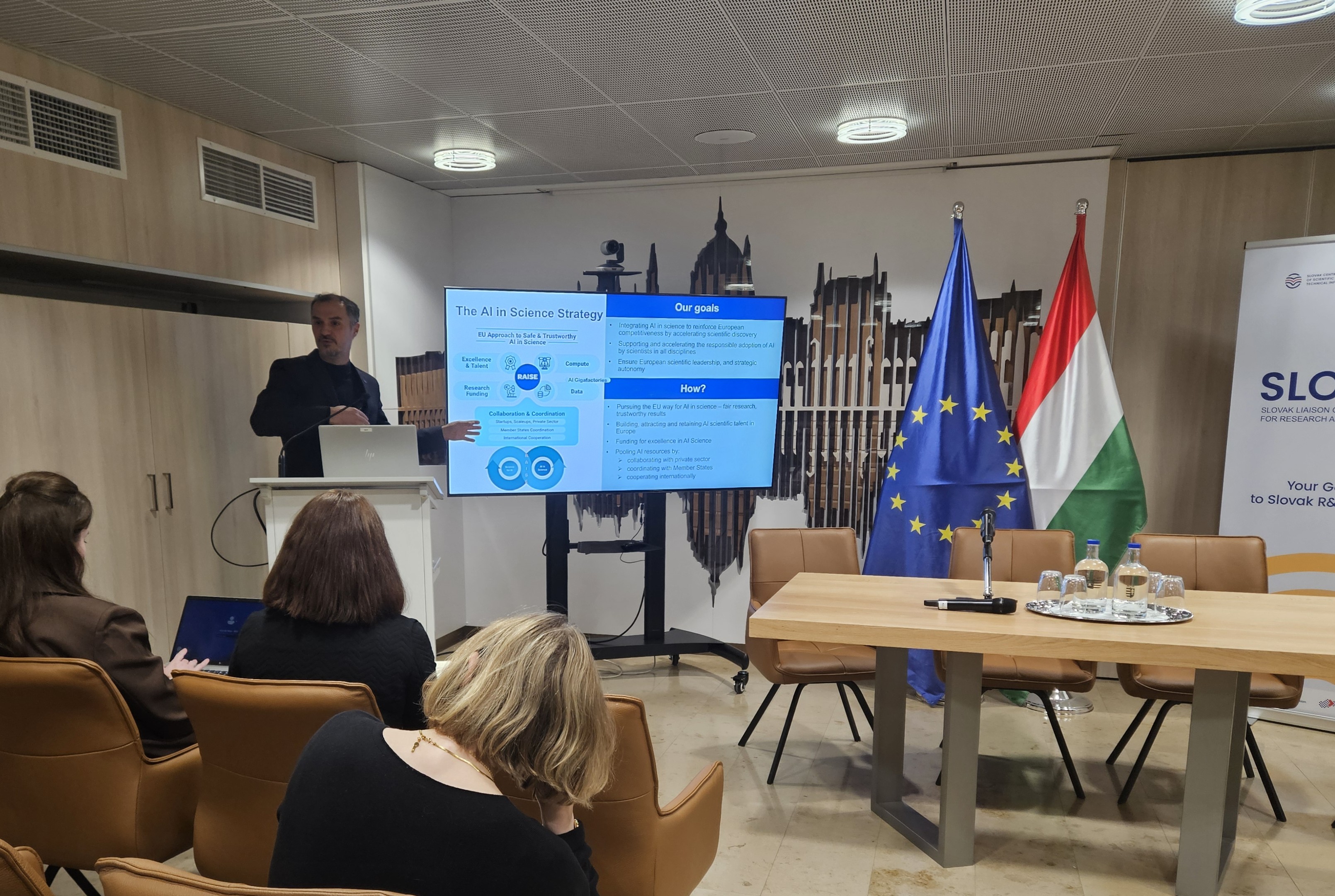
Following opening remarks by Hungarian Ambassador Katalin Molnár, Liviu Stirbat, Head of the AI in Science Unit at the European Commission’s Directorate-General for Research and Innovation (DG RTD), formally opened the conference. He presented the RAISE (Resource for AI Science in Europe) initiative and outlined its future within the EU’s next Multiannual Financial Framework, including forthcoming calls focused on the automation of scientific laboratories. He also referred to the European AI in Science Summit held in Dublin in October, where the European Commission launched the RAISE donor campaign targeting private and philanthropic funding sources. The campaign aims to support both AI research itself and the wider adoption of AI in research across scientific disciplines. Stirbat introduced the first seven contributors, including NVIDIA, Elsevier, Frontiers, Mistral, Sanofi and Google DeepMind.
AI is transforming research proposal writing and exposing systemic weaknesses
Barbara Swiatkowska, an expert from Poland’s National Science Centre (NCN), moderated the first panel discussion. She presented the results of an NCN survey that explored researchers’ attitudes towards the use of AI in writing and evaluating grant proposals. While 42% of respondents reported using generative AI when preparing proposals, more than two-thirds opposed its use in proposal evaluation. This tension also shaped the subsequent panel discussion, which featured Michal Kompan, Senior Researcher at the Kempelen Institute of Intelligent Technologies (KInIT) in Bratislava; Sophie Pornschlegel, policy analyst at the European Policy Centre (EPC) in Brussels; and Michaela Liegertová, Vice-Dean of the Faculty of Science at Jan Evangelista Purkyně University (UJEP) in Ústí nad Labem.
The panel examined both the risks and benefits of using AI in research and grant writing. Although the NCN survey revealed scepticism among some researchers, Michaela Liegertová argued that AI can save both time and resources in many areas. "Patients waiting for treatment do not care whether the latest breakthrough comes from a human or from artificial intelligence. AI can identify connections that we have not yet recognised. It can save financial resources, detect gaps in proposed experiments and thus, for example, reduce the number of animal experiments. In certain areas, using artificial intelligence is the responsible approach," she said.
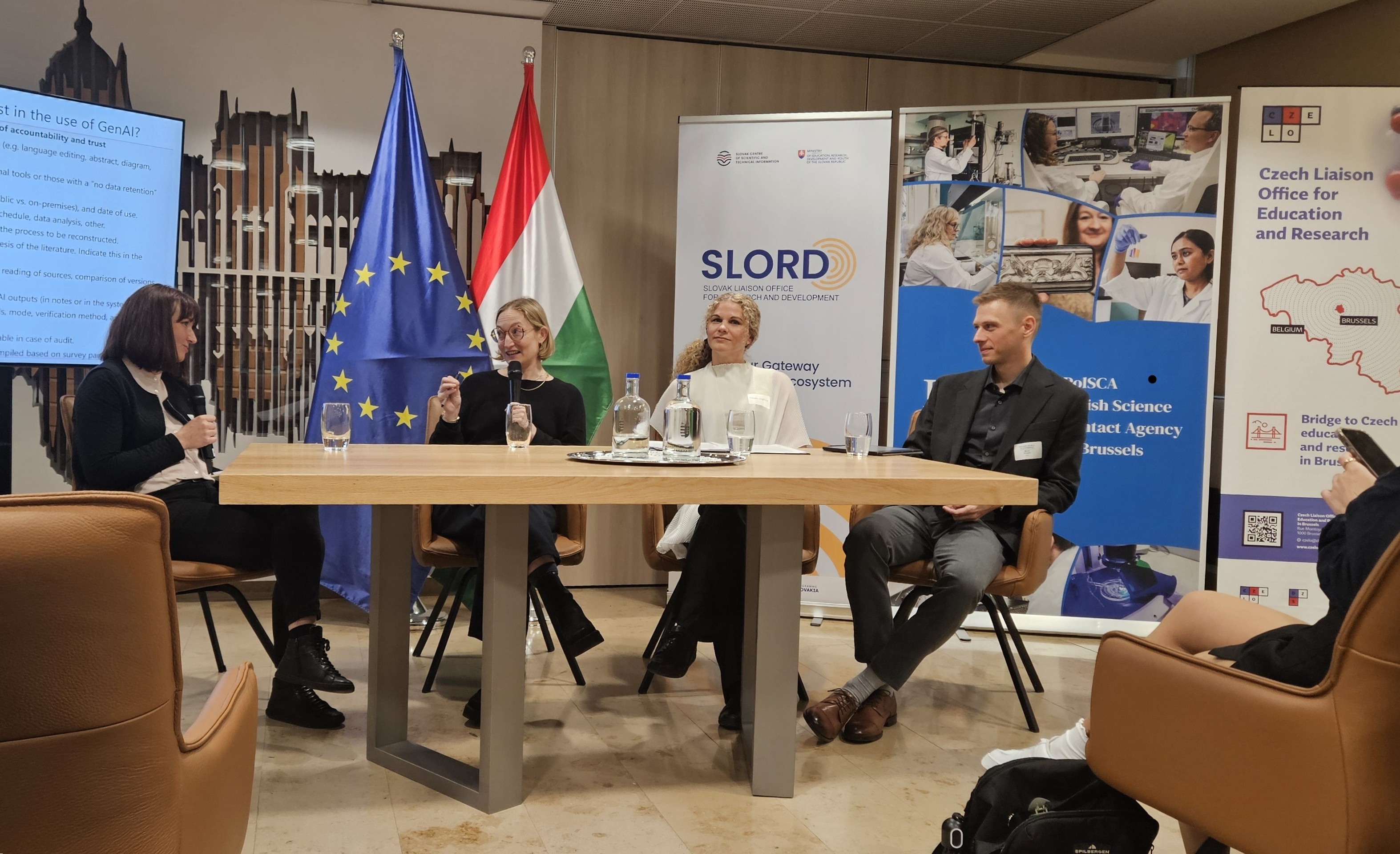
The panellists agreed that the responsible integration of AI into scientific processes requires training for both early-career and experienced researchers. Michal Kompan commented: "Researchers of the old school worked their entire careers without artificial intelligence, and we need to encourage them to adopt these new tools. At the same time, we must teach younger researchers to remain more sceptical and to verify AI-generated outputs."
Sophie Pornschlegel also argued that AI is exposing long-standing structural problems in the research system: "Researchers must publish quickly and frequently to remain relevant. Because current funding structures and the lack of long-term financial support impose this pace on them, they will increasingly rely on AI." Pornschlegel warned that unless funding systems undergo fundamental reform, they will further incentivise quantity over quality.
However, if policymakers accompany the rise of AI with reforms in research funding, stronger data sovereignty measures and comprehensive education in digital literacy, artificial intelligence could become a key foundation of scientific excellence in Europe.
“Artificial intelligence is here and it is changing our world”
The second panel built on the morning discussion and examined AI from the perspective of evaluators assessing grant proposals. Miguel Ruiz Oses from the Horizon Europe Implementation Centre at DG RTD opened the session. "The growing number of applications is placing pressure on the system. At the same time, AI could expand our ability to search and summarise information, and compare proposals," he said. He noted, however, that the important question of whether artificial intelligence will not only accelerate the evaluation process but also improve it, or whether it will undermine consistency and integrity of the entire process remains. Ruiz Oses also explained that under the European Commission’s current approach, experts cannot rely on AI tools for key tasks and must read each proposal in full in order to form an independent judgement of its scientific merit and added value. They must also refrain from uploading proposal content to any AI tool, including internal European Commission systems.
Miroslav Havránek, member of the Presidium of the Technology Agency of the Czech Republic, argued that funding organisations should reconsider what information they actually require from grant applicants. If AI can already draft certain sections of a proposal flawlessly, he suggested, those sections may no longer serve a useful purpose. Havránek also highlighted AI’s effect on narrowing score differentials among top applicants. According to him, only around 30% of MSCA proposals qualified as excellent a few years ago, whereas today the figure exceeds 70%. He compared the situation to a lottery: "If lottery tickets are cheap, everyone buys many of them to increase their chances. Thanks to AI, tickets have become very cheap. We need to make them more expensive."
Margaret Ohia-Nowak, Associate Professor at the Institute of Social Communication and Media Sciences at Poland’s Maria Curie-Skłodowska University (UMCS), highlighted racial, gender and geographical biases that appear both in the datasets used to train AI systems and in the outputs they generate. Such distortions occur most frequently in fields and topics that have historically received limited research attention. In these cases, AI tools may generate inaccurate information, which could easily influence grant evaluations if reviewers use them uncritically.
As Miguel Ruiz Oses explained at the beginning of the panel, a degree of asymmetry exists between applicants and evaluators. Applicants face virtually no restrictions when using AI to prepare grant proposals, whereas evaluators must comply with the European Commission’s rules. Nevertheless, Martin Weis from the Faculty of Electrical Engineering and Information Technology at the Slovak University of Technology (STU) in Bratislava stressed that the value of a proposal lies not in who wrote it, but in the originality and quality of its content. Researchers who submit proposals retain full responsibility for them, regardless of whether they used AI tools during the drafting process. Evaluators, meanwhile, must assess scientific merit without exposing applicants’ ideas to third parties through careless use of AI systems. In this context, Weis emphasised that prohibition is not the answer: "Artificial intelligence is here, and we cannot change that. It is here and it is changing our world. It is useful, and we must learn how to use it. Banning it is not the way forward."
The growing use of AI tools calls for clear rules and systemic reform
Although each panel approached the use of AI in science from a different perspective, participants agreed that the current system is unsustainable without comprehensive reform. AI will remain part of scientific research, and stakeholders must address the weaknesses it exposes. The panellists identified education as the starting point. Researchers need training in digital literacy, critical thinking and information verification. Safe and responsible use of artificial intelligence begins with individual users.
However, skills alone will not suffice without clear frameworks and guidance. Current rules governing the use of AI in science remain fragmented across European countries and institutions. It is often unclear what applicants should disclose, particularly given that AI tools now influence almost every stage of proposal preparation, from translation and literature searches to large language models (LLMs). Some evaluators may also hold biases against applicants who openly acknowledge using AI.
The panellists therefore emphasised the need for harmonised, transparent and practical rules that can guide researchers and grant evaluators alike. Such guidance will play a crucial role in ensuring that the growing use of artificial intelligence strengthens, rather than undermines, the quality and integrity of European research.