The workshop on European University Alliances focused on the future of Erasmus+, including the alliances, and other topics
On May 19th and 20th, more than 60 representatives from Czech universities participating in European university alliances met in Pilsen.
In May, we organised the fourth edition of a two-day workshop for representatives of Czech Higher education institutions (HEIs) that are part of European University Alliances. This year, the workshop was held at the University of West Bohemia in Pilsen and gathered more than 60 participants. These came from 13 Czech HEIs involved in European University Alliances and 3 HEIs involved in alliances that were not financially supported but received the so-called Seal of Excellence (Czech University of Life Sciences in Prague, Jan Evangelista Purkyně University in Ústí nad Labem, and the University of Pardubice). International guests also spoke during the workshop, sharing their experiences from alliances without a Czech partner (the Arqus and Unite! alliances).
Union of Skills, Pact for the Mediterranean, and the Possible Future of Erasmus+
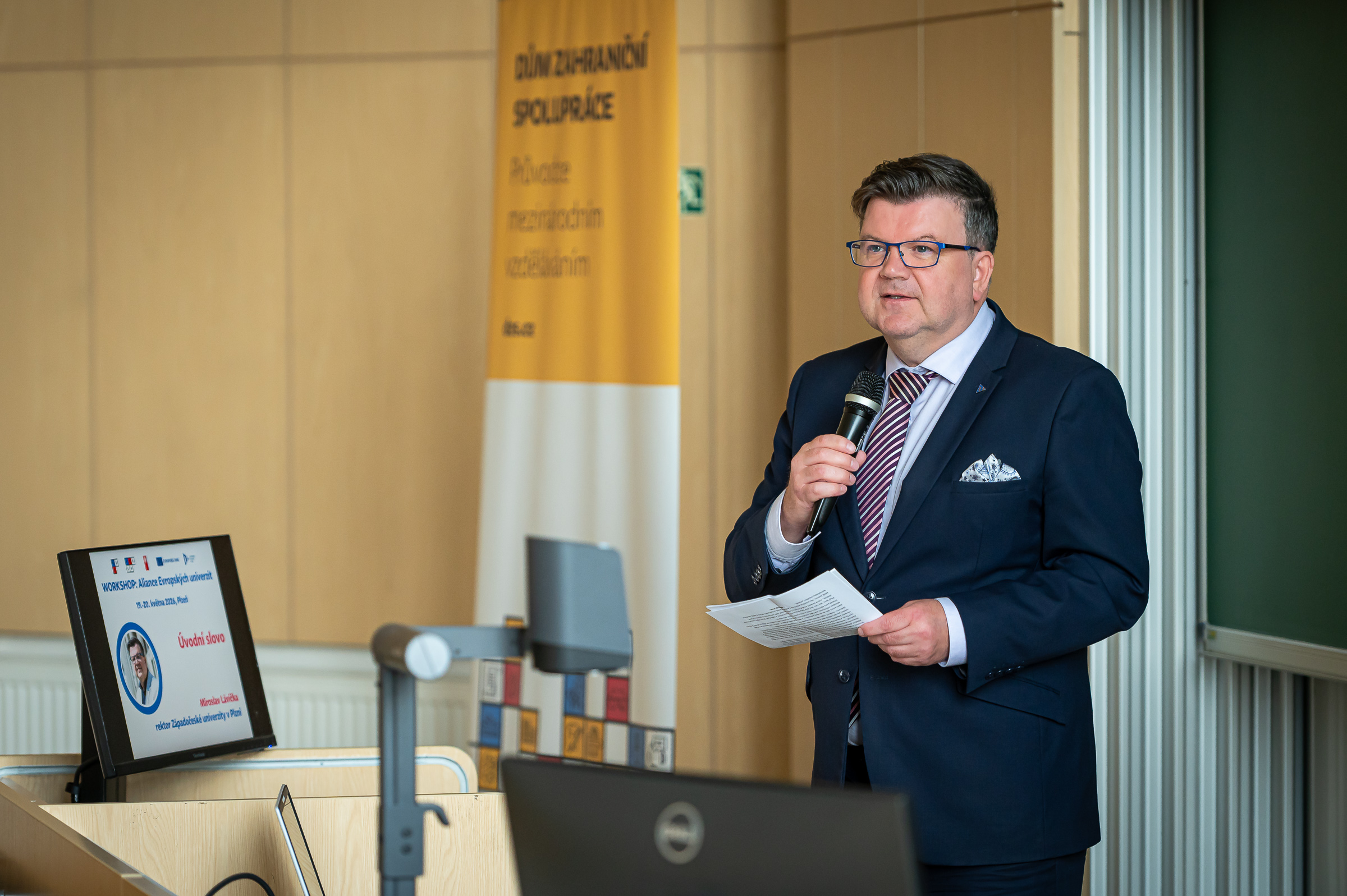
In the first part of the event, participants learnt about the topics currently being discussed in Brussels. First, they were introduced to the Union of Skills, an ambitious plan until 2030 aimed at supporting education, skills, the labour market, and the EU’s competitiveness (a combination of policies in the areas of education, vocational training, and employment). The European Commission published this strategy last March, and it remains a highly significant document whose priorities and objectives are reflected in other initiatives (such as Erasmus+ scholarships in strategic fields) as well as in the proposal for the future Erasmus+ program for the period 2028–2034. Participants also learned about the Pact for the Mediterranean, which aims to strengthen cooperation between the European Union and partner countries in the Southern Mediterranean and to connect the region in the areas of education, economy, and security.
The participants then learnt about the hottest topic in Brussels at the moment: negotiations on the future of EU programmes for the next programming period (2028–2034). In the field of education, the focus is naturally on the Erasmus+ programme, which will also incorporate the previously separate European Solidarity Corps. After the European Commission published the proposal for a regulation on the future shape of the programme last July, it has been under simultaneous discussion by both Members of the European Parliament, particularly the Committee on Culture and Education (CULT), and the Member States in the Council of the EU. Once both institutions approve their negotiating positions, they will begin mutual negotiations with the aim of reaching agreement on the final text of the regulation. Discussions are currently underway within the individual institutions, and we expect informal interinstitutional negotiations (so-called trilogues) to begin early next year. At the same time, synergies in future programmes are also being discussed, particularly between the Erasmus+, Horizon Europe, and European Competitiveness Fund programmes, especially in the context of European University Alliances.
Current developments regarding the Joint European Degree Label
During several recent meetings on the topic of European university alliances, updates regarding a potential European degree and its label were discussed. The implementation phase of the label is now approaching: the European Commission’s working group with representatives from individual member states, the European Degree Policy Lab, is set to publish a guide in June outlining the specific steps joint study programmes can take to obtain the Joint European Degree Label. Two webinars will also take place in June: an EUA webinar on June 11th and a European Commission webinar on June 16th.

Funding of alliance activities and alliance management, including financial aspects
Other parts of the programme featured presentations and more interactive sessions on various topics that are relevant across alliances. For example, participants could learn how to seek additional funding sources for alliance activities beyond the Erasmus+ alliance grant. In the field of education and innovative teaching, they can use, for instance, Erasmus+ KA1 and KA2 projects, BIPs, Erasmus Mundus, national mobility schemes, institutional co-funding, fees for participation in summer schools, etc. In the field of research, funding is available through Horizon Europe (clusters, missions, MSCA), the EIT Communities, Interreg, Digital Europe, national research and innovation programmes, and partnerships with the private sector.

Participants also learnt about various alliance management models at all levels, both among partners and within individual partner institutions and discussed practices within their own alliances. Participants agreed that there are 65 alliances and 65 different management models, with some common elements, and that there is therefore no single universal recipe for success. Another major topic of the workshop was the financial management of alliances, specifically the setup of financial flows between partners, reporting to the alliance coordinator, national authorities, and the European Commission, as well as accounting and expense tracking under the lump-sum scheme.
Other parallel sessions focused, for example, on scientific and research collaboration within the alliance, the creation of joint study programmes, and intercultural cooperation.
We are planning another meeting for next year, but you can look forward to hearing more about European universities at this year’s CEEDUCON conference.